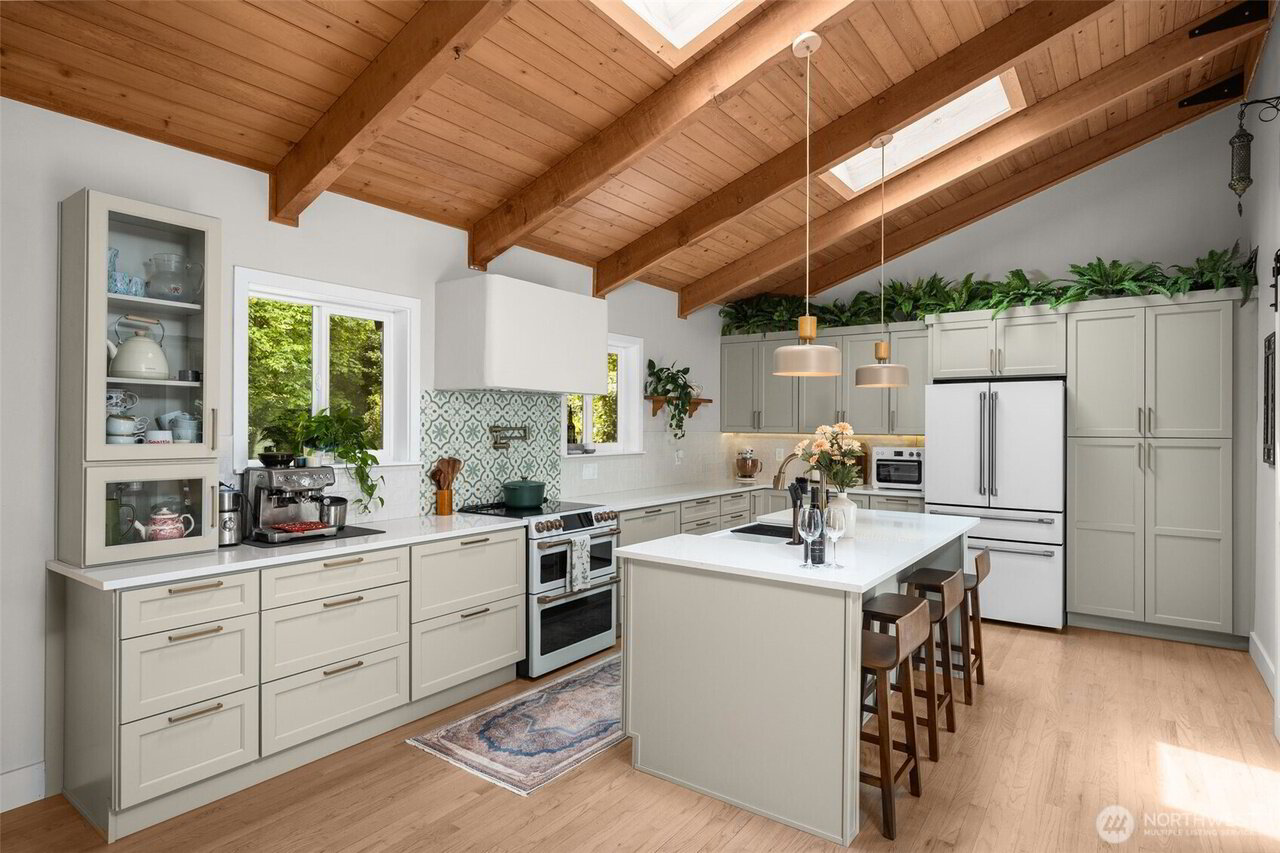
Should You Buy a $1M Home Right Now? Here's the Honest Math.
Rates are at a nine-month high. Prices just logged their 34th consecutive month of year-over-year increases. And yet this week, purchase mortgage applications were 7% higher than the same week last year. Pending home sales rose in April, both month over month and year over year.
So what do buyers know that the headlines aren’t saying?
Let’s work through it.
What the rate environment actually looks like
The 30-year fixed rate hit 6.75% earlier this week before pulling back to around 6.65% by Friday, after mid-week reports of progress on a US/Iran peace agreement moved bond markets. That context matters, because the reason rates are elevated is specific and potentially temporary.
Here’s the chain of events: When the US entered the conflict with Iran on February 28th, roughly 20% of the world’s oil supply was disrupted through the Strait of Hormuz. Oil prices surged. Rising oil prices stoke inflation fears. Inflation fears push bond yields higher. Higher bond yields push mortgage rates higher. Rates have climbed roughly 75 basis points since that date.
A peace deal changes that math. When peace deal progress was reported mid-week, the bond market responded immediately, and the average 30-year fixed rate dropped to 6.44% in a single day. That’s how fast this can move in the right direction.
The honest forecast: Fannie Mae expects rates could settle near 5.9% by year-end, while the Mortgage Bankers Association projects a higher range around 6.2% to 6.4%. The gap between those two projections tells you everything about how much uncertainty is still sitting in this market. My read is that getting comfortably below 6% in 2026 requires a verified peace agreement and sustained improvement in oil prices. Possible. Not guaranteed.
The math on a $1M purchase
Let’s use real numbers. You’re purchasing a $1M home, putting 20% down. Your loan amount is $800,000.
At today’s rate of approximately 6.65%, your principal and interest payment is roughly $5,160 per month.
If rates improve to 6.25% (a realistic scenario with partial peace deal progress), that same loan payment drops to about $4,927 per month. A difference of $233 per month.
If rates reach 5.9% (the optimistic scenario requiring a full resolution), your payment drops to approximately $4,733 per month. About $427 less than today.
That $427 spread is real money. But here’s the question worth sitting with: how much does waiting cost you on the price side?
The median existing home price hit $417,700 in April, the 34th consecutive month of year-over-year price appreciation. In the Seattle market, $1M+ inventory has remained tight and well-supported by demand. A 3% price increase on a $1M home adds $30,000 to your purchase price and roughly $160 per month to your payment regardless of what rates do.
Waiting for a rate improvement can easily be offset by price appreciation. That’s the core tension in this market right now.
Cash to close: what to actually budget
On a $1M purchase with 20% down, plan for the following:
Down payment: $200,000
Closing costs typically run 1.5% to 2% of the loan amount on a jumbo purchase in Washington state. On an $800,000 loan, that’s $12,000 to $16,000. Budget toward the higher end.
Prepaid items (homeowners insurance, property tax reserves, prepaid interest) typically add another $4,000 to $7,000 depending on timing of close.
Total cash to close: plan for $218,000 to $225,000 all in, conservatively.
The refinance conversation
If you buy today at 6.65% and rates improve meaningfully in 2026 or 2027, you refinance. The cost to refinance a jumbo loan is typically $3,000 to $5,000 in closing costs. If a rate drop of 0.5% saves you $230 per month, you break even in 13 to 22 months. That’s a straightforward financial decision when the time comes.
What you cannot do is refinance the purchase price. If you wait and the home you want sells for $50,000 more, that cost is permanent.
What this week’s data is actually telling you
Buyers who have been waiting since February 28th are starting to move. Not because rates improved significantly, but because they’ve accepted that certainty isn’t coming on any predictable timeline. Full oil flows through the Strait of Hormuz will not return before the first or second quarter of 2027, even if the conflict ended today, according to the head of ADNOC. The buyers moving now have done the math and decided the home matters more than the rate.
That’s not a reckless decision. It’s a rational one.
The rate is refinanceable. The price is not. If the home makes sense at today’s payment, and you have the cash reserves to close comfortably, waiting for a better rate is a speculative bet on geopolitical outcomes, not a financial strategy.
If you want to run your specific numbers, that’s exactly what I’m here for.
